Quick Verdict
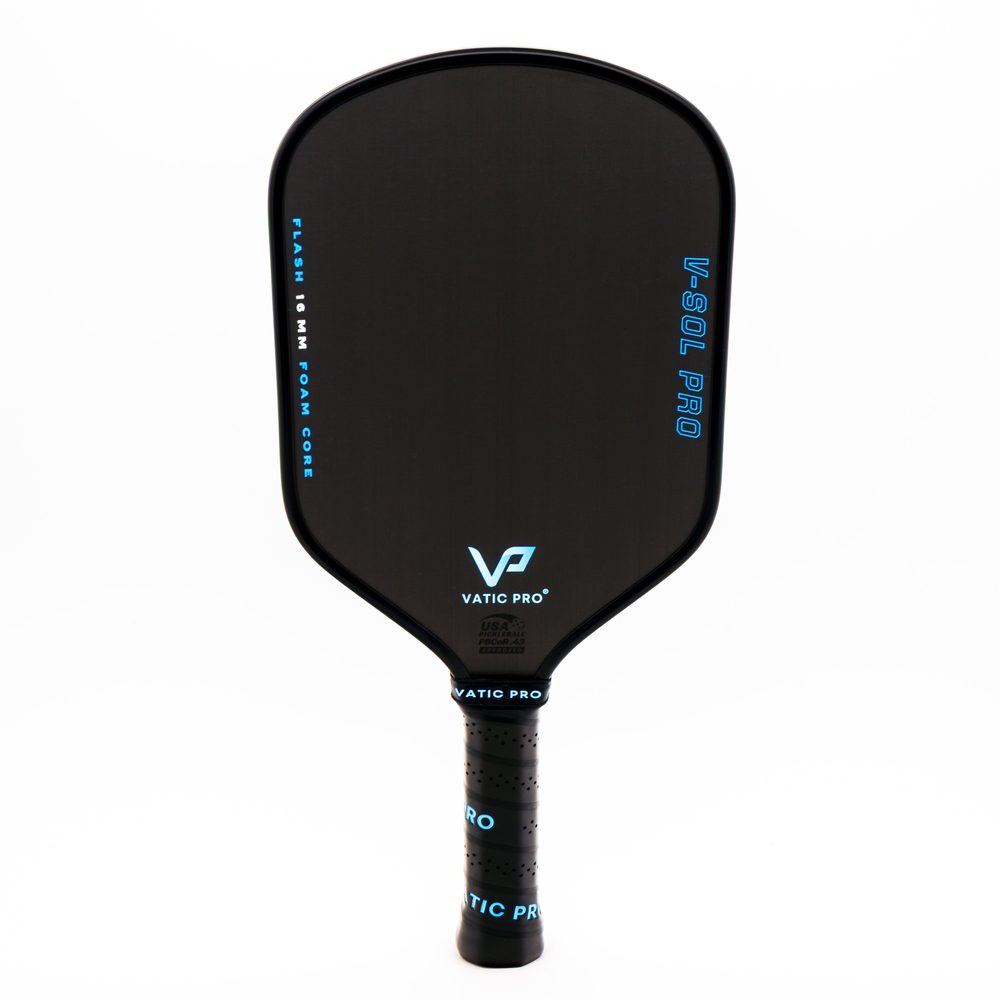
After six weeks and 40+ hours on court, we put the Vatic Pro V-Sol Pro 16mm through its paces. Spoiler: it's absurdly good for $99.
What We Liked
- Best-in-class spin for any paddle under $150
- Dual foam core feels noticeably softer and more arm-friendly than polymer
- Explosive pop at the baseline — full swings are genuinely rewarding
- Light and maneuverable for a 16mm paddle at ~8.1 oz
- Comes with a quality paddle cover included
- USAP approved for tournament play
Watch Out For
- Light weight means less stability on off-center hits
- Some vibration feedback on hard drives — sensitive arms may notice
- Core durability over 6+ months is still an open question
- Not ideal for players who prefer a planted, heavier feel
Full Specifications
| Core | Dual foam — EPP floating core + EVA foam perimeter ring |
| Surface | Toray T700 raw carbon fiber (textured) |
| Thickness | 16mm |
| Weight | 8.0–8.2 oz (227–232g) |
| Handle Length | 5.3 inches |
| Grip Circumference | 4.25 inches |
| Paddle Length | 16.5 inches |
| Paddle Width | 7.5 inches |
| Shape | Elongated |
| USAP Approved | Yes |
| Price | $99–$109.99 (includes cover) |
I’ll be straight with you: I came into this review with my arms crossed.
I’ve been playing pickleball competitively for three years — currently a solid 4.0, grinding to break into 4.5 — and I’ve watched enough “budget paddle” hype cycles to know how they usually end. A company releases something at $99 that supposedly competes with $220 paddles. The subreddit loses its mind. You buy one. It’s fine for six weeks. Then the core starts deadening, the spin texture wears smooth, and you’re back where you started.
So when Vatic Pro’s V-Sol Pro landed on my doorstep — elongated shape, 16mm, dual foam core — I wasn’t about to fold at the marketing copy. I played it for six weeks straight: roughly 40+ hours across daily dinking sessions, open play at two different clubs, and one local 4.0 tournament. This is what I actually found.
First Impressions: It Doesn’t Feel Like a $99 Paddle
The packaging is simple but the paddle itself immediately telegraphs quality. The raw T700 carbon fiber surface has a gritty, almost sandpaper-like texture that you don’t often feel on budget sticks. Run your thumb across it and you understand immediately why people talk about the spin on this thing.
Weight & Balance
Weight came in at 8.1 oz on my scale — right in the middle of Vatic’s claimed range. The handle feels slightly thin at 4.25” circumference, but an overgrip brings it right into comfortable territory. Balance point is head-light, which suits the elongated shape well.
What’s in the Box
The included paddle cover is a genuine nice-to-have. It’s not the cheap neoprene sleeve you’d expect at this price — it’s a semi-rigid zippered case that actually protects the surface. Small thing, but it adds to the sense that Vatic took this seriously.
The Tech: What “Dual Foam” Actually Means
Most pickleball paddles use a polymer honeycomb core — a hexagonal structure that offers consistent response but is prone to “dead spots” over time as the walls collapse under repeated impact. Vatic went a different direction with the V-Sol Pro.
The core here is a floating EPP (expanded polypropylene) foam surrounded by an EVA foam perimeter ring — two different materials working together. The EPP center is springy and energy-returning, while the EVA ring around the edges softens the feel and adds touch.
The whole thing is laminated under heat and pressure (thermoformed) against the T700 carbon face, creating a single unified structure with no air gaps.
The result plays softer than a standard 16mm polymer paddle. That’s not just marketing speak — you feel it immediately, especially in dinking exchanges where the ball stays on the face a fraction longer before releasing.
The Kitchen Game: Where It Shines Brightest
If I had to pick one category where the V-Sol Pro flat-out won me over, it’s the soft game.
Dinking & Touch Shots
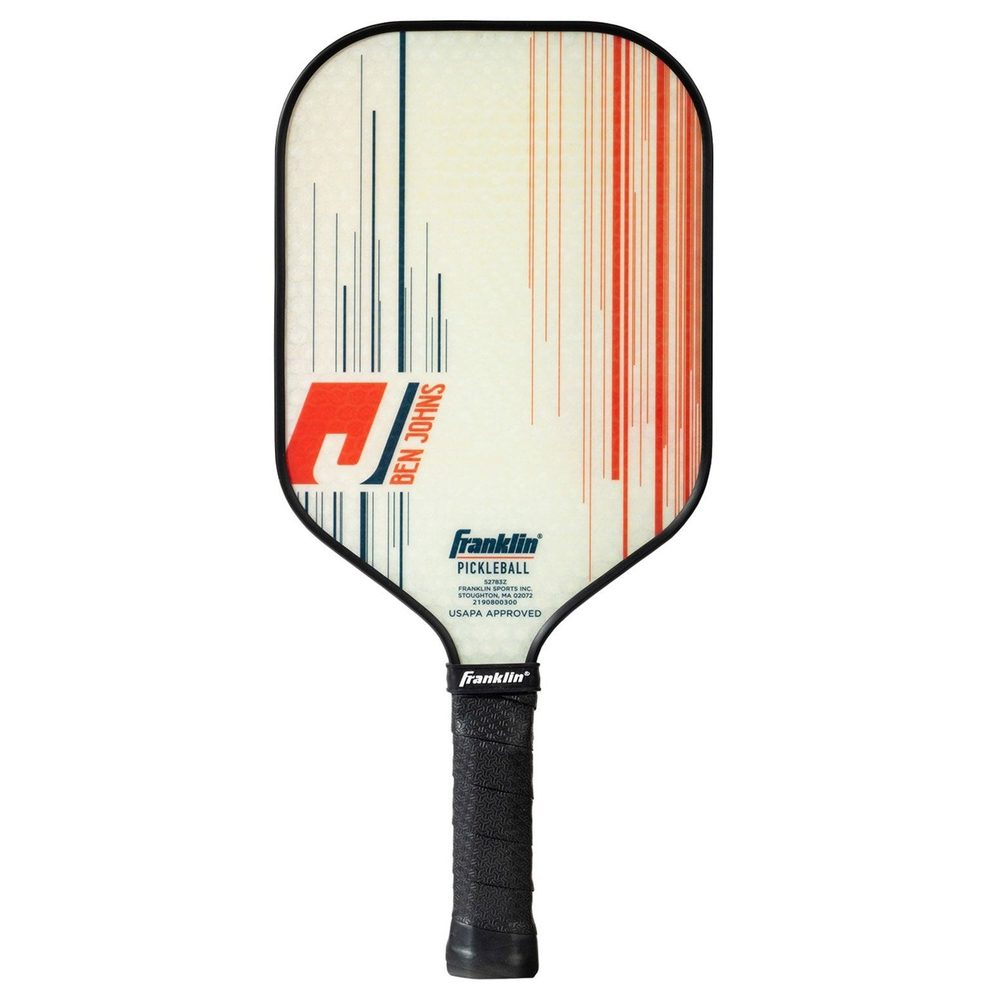
The foam core changes the dinking equation meaningfully. Touch shots feel more predictable. When you’re in a fast-hands exchange at the net, there’s something about the way this paddle absorbs and then redirects pace that just clicks. I was generating angles I wasn’t finding with my usual paddle (a Joola Ben Johns Hyperion at roughly double the price).
Third-Shot Drops & Spin
The T700 surface creates vicious topspin on third-shot drops. Once you dial in the stroke, you can generate a steep ball arc that lands short and kicks up aggressively — the kind of shot that forces your opponents back onto their heels.
“In open play, I had multiple partners stop mid-point to ask what paddle I was using. The spin coming off my forehand roll wasn’t something they were used to seeing from a $99 stick.”
I also found the slice shots unusually satisfying. The raw carbon grabs the ball from underneath and imparts genuine backspin. Pushed cross-court with weight behind it, the ball kicks away low and fast on the bounce — a real weapon in rallies.
Baseline Power: Genuinely Surprising
I’ll admit I expected the foam core to sacrifice some pop. It didn’t.
Full swings off the baseline generate impressive pace. The EPP core seems to store and return energy efficiently — it’s not a dead thud, it’s a crisp launch. Serves with heavy topspin loaded up well, and overhead putaways felt authoritative rather than wimpy.
The Elongated Shape Advantage
The extended face gives you more reach on wide balls and adds leverage on swings, which translates to shot pace even if you don’t perfectly center the contact. It’s a meaningful upgrade from a standard shape for baseline players.
That said, power players coming from a stiff carbon paddle might notice a slight adjustment period. The foam softens the response just enough that truly flat, driveball-style shots feel a hair mushier. If you’re a 4.5+ player who relies on pure heavy pace, budget a week to recalibrate.
The Stability Problem (And the $5 Fix)
Here’s the honest critique: the V-Sol Pro is light for a 16mm paddle, and lighter, head-light paddles punish off-center hits.
At ~8.1 oz it’s technically midweight, but it’s one of the lightest 16mm paddles on the market and the balance sits head-light. The practical result is a narrower effective sweet spot on mishits than heavier, head-heavy alternatives. When you catch the edge on a hard drive or mis-hit a block, the paddle twists slightly and the ball goes wide. It’s not catastrophic, but it’s noticeable in fast exchanges.
The Lead Tape Solution
The fix that the pickleball community has converged on — and that I tested for the last two weeks — is lead tape. Two small strips at 3 and 9 o’clock (roughly 4–6 grams total):
- Expands the effective sweet spot
- Makes mishits more forgiving
- Slightly heavier feel helps with vibration absorption
- Doesn’t meaningfully hurt maneuverability
If you buy this paddle, budget $5 for lead tape. It’s not optional — it’s a mandatory upgrade.
Arm Feel: The Honest Take
There are conflicting reports online about arm comfort, and I want to address this carefully because it matters.
The Good News
The foam core is genuinely softer than polymer, and that translates to reduced peak shock on impact. Players recovering from tennis or pickleball elbow generally report positive experiences with foam-core paddles for this reason — the EVA perimeter especially absorbs off-center impact energy.
The Caveat
The light weight means the paddle has less mass to absorb impact. On hard-contact shots — drives, blocks against big hitters, overhead putaways — there’s a sharper vibrational feedback compared to heavier paddles. A couple of players at my club who are sensitive to arm pain tried it and felt that feedback acutely.
Bottom line on arm feel: If you have existing elbow issues, add lead tape first and start with soft exchanges. Don’t jump into a hard practice session on day one.
How It Stacks Up Against the Competition
At $99, the V-Sol Pro has essentially redefined what you can get at this price point. Here’s how it measures up:
vs. Joola Ben Johns Hyperion 16mm (~$160)
The Hyperion has a slightly larger sweet spot, marginally better stability on mishits, and a more dampened feel. But the V-Sol Pro spins as hard — maybe harder — and while the Hyperion’s price has dropped to around $160, that’s still a ~$50 premium the V-Sol Pro’s performance doesn’t ask you to pay.
Winner: V-Sol Pro on value. Hyperion if stability is non-negotiable.
vs. Selkirk Vanguard Power Air (~$180)
Exceptional feel and touch, especially at the kitchen. The foam construction is excellent. But the V-Sol Pro competes on spin and isn’t far behind on feel. You’re paying a significant premium for marginal gains and brand cachet.
Winner: V-Sol Pro — it’s not close at this price delta.
vs. Paddletek Tempest Wave Pro-C (~$150)
Good all-around paddle, but it’s polymer core and the spin gap is noticeable. At around $40–50 more, the V-Sol Pro wins comfortably.
Winner: V-Sol Pro, decisively.
Who Should (and Shouldn’t) Buy This
Buy It If You:
- Are upgrading from your first paddle and want something genuinely competitive
- Play 2–4 times a week and want a serious all-around stick
- Love topspin and want to build a kitchen-dominant game
- Want USAP approval for tournament play without spending $200+
- Are a 3.0–4.0 player looking for elite-level technology at a budget price
Skip It If You:
- Are a heavy-hitting power player who needs maximum stability from the factory
- Have existing arm issues and are sensitive to vibration (add lead tape first at minimum)
- Want a durable “forever” paddle — foam core longevity beyond 12 months is still an open question
The Verdict
Six weeks in, I’m still reaching for the V-Sol Pro. That’s probably the most honest endorsement I can give.
It’s not a perfect paddle. The out-of-the-box stability is the weakest link, and arm-sensitive players should approach with caution. But the spin, the kitchen touch, the baseline pop — and the absolute value proposition at $99 — make this one of the most compelling paddles on the market at any price point.
Add lead tape. Grab an overgrip if the handle feels thin. And try not to feel too weird about the fact that your $99 paddle is making your 4.5 partner nervous at the net.
How we test
Every paddle on Dink Report is tested on court over multiple weeks of real play — not just unboxed and spec-checked. Ratings are independent and never influenced by whether a paddle was purchased or supplied. Read more about our review methodology.
More Reviews