Most recreational doubles points are lost on positioning, not shotmaking. Two players who move as a team and get to the right spots will beat two better ball-strikers who don’t. This guide covers where to stand and when to move.
The Golden Rule: Move as a Pair
The most important concept in doubles is that you and your partner move together, like you’re connected by an invisible rope about 10 feet long. When one of you moves up, the other moves up. When one shifts left to cover a shot, the other shifts left too. This keeps your court coverage even and closes the gaps opponents love to exploit.
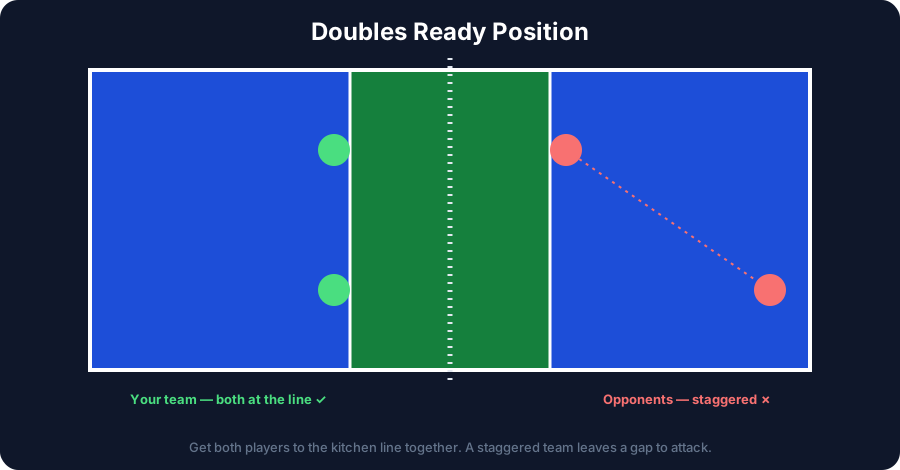
Get Both Players to the Kitchen Line
The team with both players at the kitchen line wins the large majority of points. From the line you can:
- Take balls out of the air before they drop to your feet.
- Cut off your opponents’ angles.
- Apply pressure with dinks and volleys.
A staggered team — one player up, one back — has a gaping hole in the middle and at the feet of the back player. Your goal on every point is to get both players up together; your goal against a staggered team is to attack the gap.
The Ready Position
At the kitchen line, set up in an athletic ready position:
- Paddle up and out in front, around chest height, in the middle of your body.
- Knees bent, weight on the balls of your feet.
- Backhand ready — most quick exchanges at the net come to the backhand side, so default your paddle there.
- Eyes on the ball and the opponent’s paddle, not on your own feet.
Who Takes the Middle?
Balls down the middle cause the most confusion. Default rules of thumb:
- The player whose forehand is in the middle takes it (forehands are stronger and have more reach).
- Communicate — call “mine” or “yours” early. Most middle balls are lost to hesitation, not skill.
- The player who hit the last shot is often better positioned to take the next middle ball.
Court Coverage Basics
- Cover your shot. After you hit, recover toward the middle of the area you’re responsible for.
- Shift with the ball. When the ball is on the left sideline, both players slide slightly left — the down-the-line shot is the bigger threat than the crosscourt one.
- Don’t chase your partner’s ball. Trust them to cover their side; you cover yours.
Stacking (The Next Step)
Stacking is an advanced positioning trick where partners line up on the same side before the serve or return, then switch to their preferred sides afterward. Teams stack to:
- Keep a stronger player’s forehand in the middle.
- Keep a lefty/righty pairing’s forehands in the center.
- Hide a weaker backhand.
You don’t need stacking as a beginner — but it’s worth knowing it exists. Once you and a regular partner have set sides you each prefer, stacking lets you keep those positions regardless of the score. Start simple: master moving as a pair and getting to the line first.
Since your side switches every time your team scores, it’s easy to lose track mid-game. Our free Score Keeper tracks the score and the serving team for you — handy when both partners are focused on the rally.
Quick Checklist
- Move as a pair, connected by an invisible rope.
- Get both players to the kitchen line.
- Paddle up, knees bent, backhand ready.
- Call the middle early — communicate.
- Shift toward the ball’s side to cover the down-the-line threat.
Fix your positioning before you chase a better paddle or a bigger forehand. Two disciplined players who move together are remarkably hard to beat. For the rules that underpin all this, start with our kitchen rules guide and scoring guide.