Quick Verdict
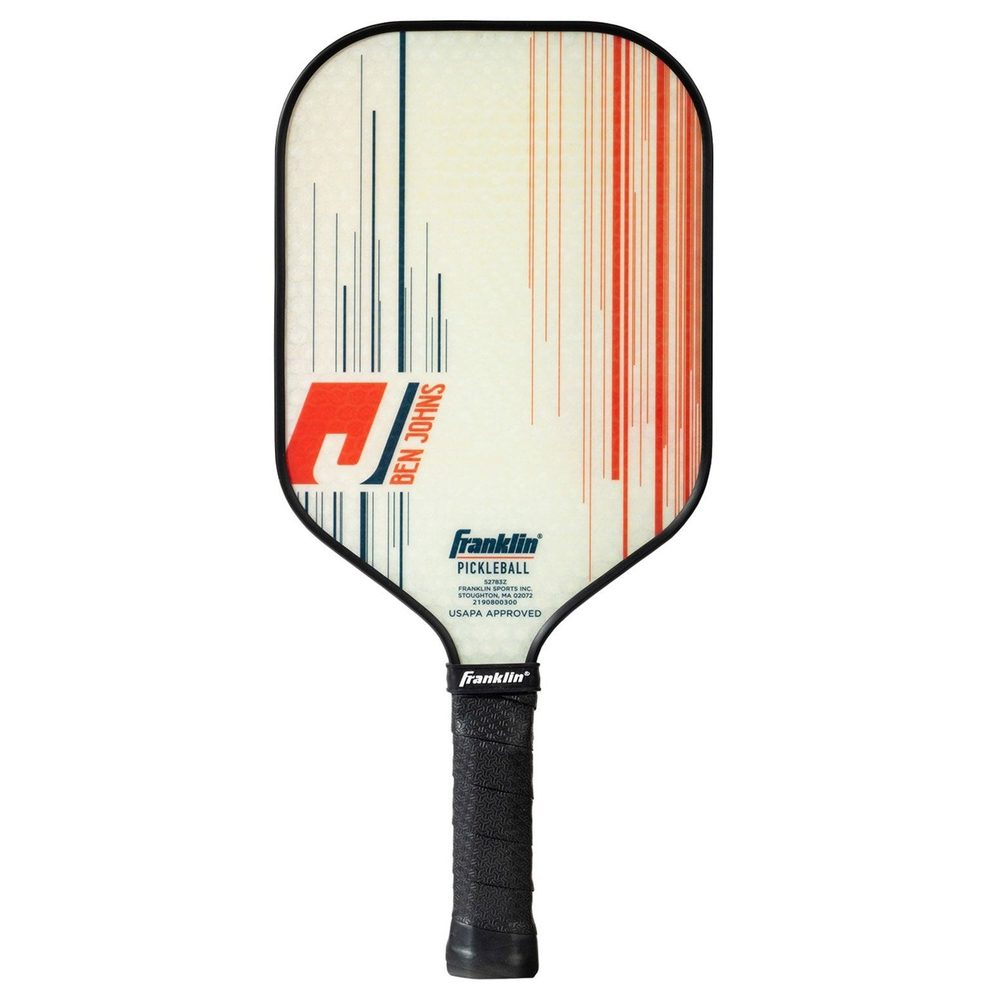
Franklin's Ben Johns signature paddle streets around $70 and is one of the best bang-for-buck options for new players. It plays better than it has any right to at this price.
What We Liked
- Exceptional value — genuinely competitive play around $70
- Good all-around balance of power and control
- Lightweight and maneuverable for quick net exchanges
- Great starter paddle for beginners wanting quality
- Ben Johns' actual input on shape and weight
Watch Out For
- Carbon fiber surface less aggressive than raw carbon alternatives
- Core will deaden faster than premium polymer options
- Won't satisfy 4.0+ players for long
- No foam core option at this price
Full Specifications
| Core | Polymer honeycomb (MaxGrit) |
| Surface | Carbon fiber |
| Thickness | 13mm |
| Weight | 7.5–8.0 oz |
| Handle Length | 5.6 inches |
| Grip Circumference | 4.25 inches |
| Paddle Length | 16.5 inches |
| Paddle Width | 7.5 inches |
| Shape | Elongated |
| USAP Approved | Yes |
| Price | $69.99–$99.99 |
Most celebrity-endorsed budget paddles are cash grabs. Slap a famous name on a generic OEM paddle, raise the price 30%, call it a day. The Franklin Ben Johns Signature paddle is not that.
At around $70 — and often on sale below that at big-box stores, against a $99.99 list price — this is genuinely one of the best entry-level paddles you can buy. It’s not going to compete with $200 premium options, but it plays significantly better than most paddles in its price bracket, and the elongated shape with a thin 13mm core reflects real input from Ben Johns’ game style.
Who This Paddle Is For
This is an entry point, not a forever paddle. If you’re brand new to pickleball, upgrading from a starter set, or buying a second paddle for guests — this is the answer. At this price you get a real carbon fiber face, a reasonable polymer core, and an elongated shape that performs at the kitchen and baseline.
When you’ve improved enough that this paddle’s limitations become a barrier (usually around the 3.5 level), you’ll know exactly what to look for in an upgrade.
On-Court Feel
The 13mm core is thinner than the 16mm control-oriented paddles — you get a snappier response and a bit more pop, with slightly less feel at the kitchen. For beginners, this is fine. The pop is rewarding and confidence-inspiring. The touch is adequate for basic dinking.
As you improve and start spending more time at the non-volley zone, you may want the softer feel that 16mm paddles offer. That’s your signal to upgrade.
The Carbon Fiber Question
The carbon fiber face on the Ben Johns Signature isn’t raw carbon — it’s a smoother carbon surface that generates decent spin but doesn’t match the gritty texture of raw T700 or similar. For beginners learning spin technique, this is a minor point. For players who’ve developed aggressive spin shots, the difference is noticeable.
Kitchen Play at the 3.0–3.5 Level
At the kitchen line, the 13mm core produces a feel that’s snappier than what you’d get from a 16mm control paddle. For beginners, this is actually an advantage — it makes the ball feel lively and responsive, and basic dinking is easy to learn because the paddle gives clear feedback.
Where it shows a seam is in long, contested dink rallies. The thinner core doesn’t absorb pace as well as 16mm paddles, so a hard ball reset requires better touch to stay in the kitchen. Beginners aren’t usually in 15-shot dink rallies, so this doesn’t matter much early on — but it’s the first limitation you’ll feel as you improve.
The Elongated Shape Advantage
Ben Johns actually plays an elongated paddle, and his input on the shape is visible in this one. The 16.5-inch length extends your reach at the non-volley zone — useful for covering more of the kitchen line — and gives you additional leverage on drives from the baseline. For players developing their game, an elongated shape is a good habit to build on, because it’s closer to what you’ll use when you move up to a premium paddle.
The trade-off is a narrower sweet spot than a standard shape. Off-center hits on an elongated paddle lose more than off-center hits on a wider paddle. For beginners this is noticeable, but not a dealbreaker — it teaches you to make better contact, which is a net positive.
How It Compares to the Next Price Tier
When players outgrow the Ben Johns Signature — usually around the 3.5 level — the specific things they notice are: spin ceiling on heavy topspin shots, core softness under sustained pressure, and pop at the baseline against players who drive hard. These aren’t flaws, they’re just what $70 gets you. The upgrade path is clear: a mid-range carbon paddle in the $100–$130 range, or a thermoformed all-around option if you’re ready to spend more.
The Ben Johns Signature is honest about what it is. It doesn’t pretend to compete with premium options, and the price doesn’t pretend either.
Durability
Polymer cores at this price tier deaden faster than premium options. A casual player (2x per week) will likely get 12+ months of solid performance. Frequent players (4–5x per week) may feel the core soften at 6–8 months. That’s the trade-off for the price — and it’s a fair one. At $70, you’ve spent less than two months of premium-paddle depreciation.
Who Should Buy This
- New players who want a real paddle (not a big-box set) without a $150+ commitment
- Casual players who play once a week and don’t need pro-level equipment
- Parents buying for kids who may or may not stick with the sport
- Players buying a guest paddle to keep at home
Pass if you’re already past the 3.5 level and playing competitively — the limitations will frustrate you within a few months. But for its actual audience, this paddle earns every bit of its reputation.
The Verdict
The Franklin Ben Johns Signature is the first paddle I’d recommend to a new player who wants to take the sport seriously without risking $200 on gear before they know if they’ll stick with it. It overperforms for the price, plays well, and sets good habits with its elongated shape and balanced feel.
When you outgrow it, you’ll outgrow it quickly — but you’ll know exactly what you want in your next paddle. That education is worth something too.
How we test
Every paddle on Dink Report is tested on court over multiple weeks of real play — not just unboxed and spec-checked. Ratings are independent and never influenced by whether a paddle was purchased or supplied. Read more about our review methodology.
More Reviews