The third-shot drop is the shot that lets you take control of a point — and it’s the single biggest skill gap between intermediate and advanced players. Understanding why it exists is the first step to hitting it well.
The Problem It Solves
The serving team starts at a disadvantage. Because of the two-bounce rule, the serve must bounce and the return must bounce before anyone can volley. That means the serving team is stuck back near the baseline until their third shot, while the returning team gets to rush up to the kitchen line.
So the serving team’s third shot (the first one they’re free to do anything with) has a job: get to the kitchen line safely to neutralize the returners’ advantage. There are two ways to do it — the drop and the drive.
What Is the Third-Shot Drop?
The third-shot drop is a soft shot from near the baseline that arcs up and drops gently into the opponent’s kitchen. Done right, it’s unattackable — the opponents at the net have to let it bounce or hit up on it, which gives you and your partner time to move forward to the line.
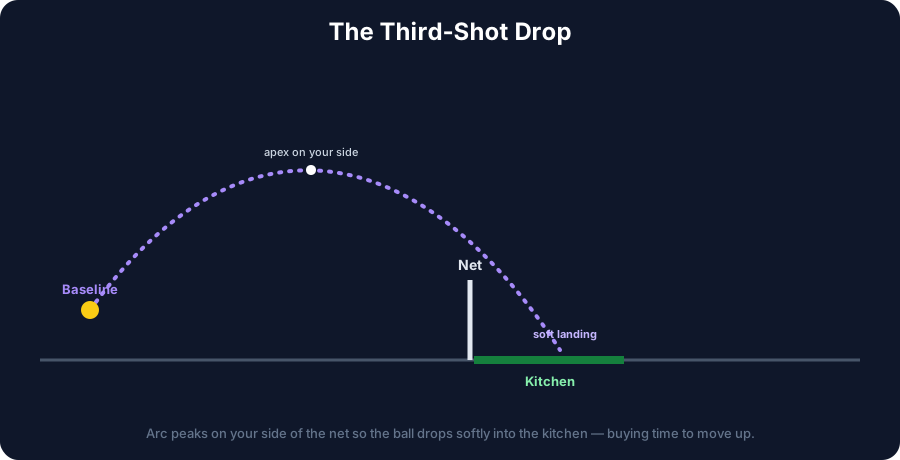
The key is the arc: the ball should peak on your side of the net and be descending as it crosses, so it lands soft and low in the kitchen rather than sailing in high and attackable.
Drop vs. Drive
There are two schools of thought on the third shot:
| Third-Shot Drop | Third-Shot Drive | |
|---|---|---|
| Goal | Reset the point, advance to the net | Pressure opponents, force a weak reply |
| Risk | Net errors if too low | Sits up for a counter if too flat |
| Best when | Opponents are set at the line | You get a high, soft return |
| Skill needed | Touch and arc control | Power and placement |
Most advanced players mix both. A common modern pattern is the drive-then-drop: drive the third shot to force a pop-up, then drop the fifth shot to come in. But the drop is the foundational skill — if you can only learn one, learn the drop.
How to Hit a Third-Shot Drop
- Get under the ball. Bend your knees and prepare low. The drop is a lifting shot.
- Use a low-to-high swing. A gentle upward path creates the arc. Keep the swing compact.
- Soft grip, no wrist. Like a dink, use a loose grip and push with the shoulder — don’t slap it.
- Aim for the apex on your side. Picture the ball peaking just before the net and falling into the kitchen.
- Move in behind it — but split-step. As you follow your drop forward, split-step before your opponent contacts the ball so you’re balanced for the next shot. Don’t sprint blindly to the line.
When NOT to Drop
The drop is high-risk from a bad position. If the return lands deep and pushes you behind the baseline, a drop is very hard — you’re better off resetting with a higher, safer ball or driving. Only attempt the textbook drop when you’re balanced and inside or near the baseline.
Common Mistakes
- Hitting it too low → into the net. Give it arc; height over the net is fine if it still lands short.
- Hitting it too hard → it sails deep and sits up. Soft hands.
- Standing still after the drop → the drop earns you the right to move up. Use it.
- Trying to drop from way behind the baseline → low percentage. Reset instead.
Drill It
Stand at the baseline with a partner at the kitchen line feeding you returns. Hit nothing but drops, aiming to land them in the kitchen. Track your make rate over 20 attempts and watch it climb. This one drill will do more for your game than almost anything else.
The third-shot drop is humbling at first and transformative once it clicks. It’s the bridge from “hitting hard and hoping” to actually controlling points. Pair it with a soft, controllable paddle — our best paddles list flags the control-friendly options.