Quick Verdict
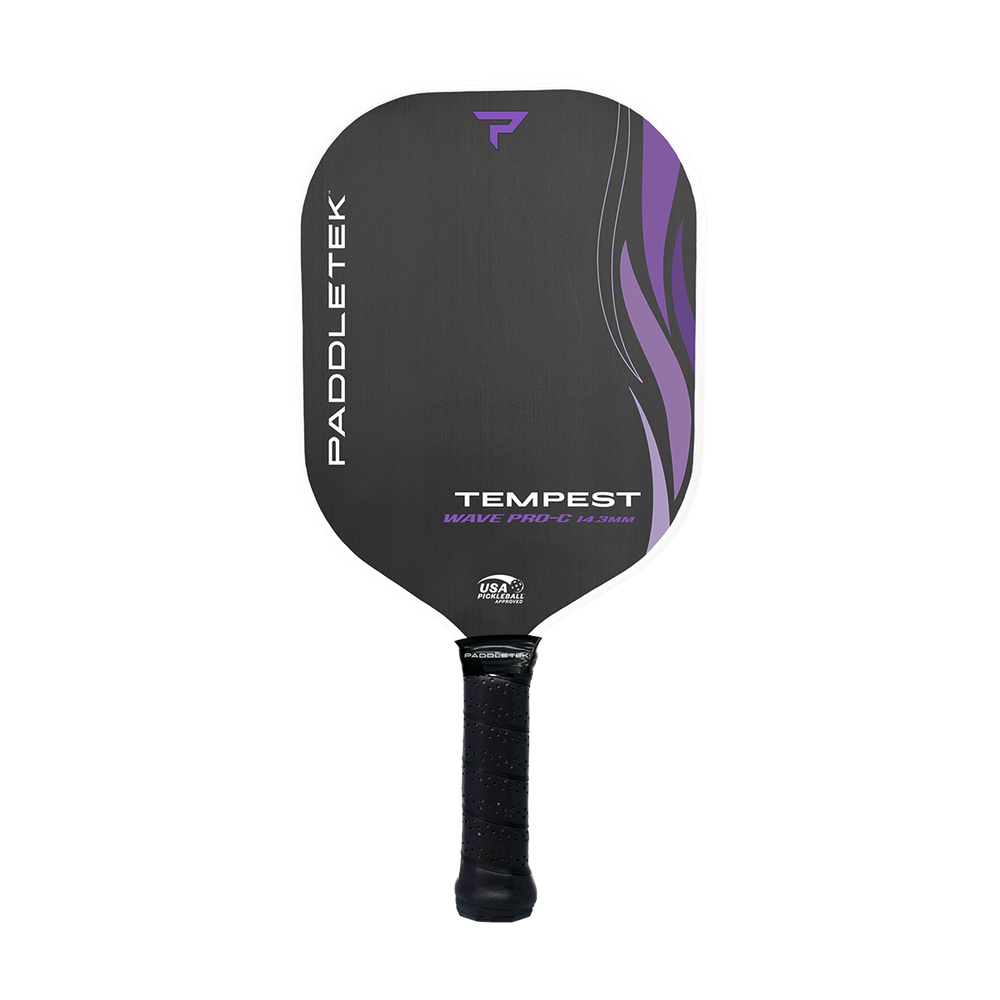
Paddletek's Tempest Wave Pro is a solid, consistent performer that delivers dependable all-around play. Not flashy — just works.
What We Liked
- Reliable, consistent performance across all situations
- Tempest SRT polymer core holds its feel over time
- Great for all-around players who don't want to sacrifice anything
- Made in the USA with strong quality control
- Durable — core resists deadening longer than most
Watch Out For
- Less spin than raw carbon fiber alternatives
- Doesn't excel dramatically at anything — may feel unexciting to power players
- Pricier than comparable graphite paddles
- Graphite face texture is milder than raw carbon competitors
Full Specifications
| Core | Tempest SRT polymer honeycomb |
| Surface | Textured graphite |
| Thickness | 14mm |
| Weight | 7.6–8.0 oz |
| Handle Length | 5.25 inches |
| Grip Circumference | 4.375 inches |
| Paddle Length | 15.875 inches |
| Paddle Width | 8 inches |
| Shape | Standard |
| USAP Approved | Yes |
| Price | $149.99 |
Paddletek has been making paddles in the USA since before pickleball became a mainstream sport. They don’t court controversy, don’t sponsor drama, and don’t release paddles with wild claims. They make durable, well-built paddles — and the Tempest Wave Pro is a good example of what that philosophy produces.
This is a paddle that does everything adequately and several things well. It’s not going to wow you in any one category. It’s going to show up every session, play consistently, and last.
The Tempest SRT Core
Paddletek’s Tempest SRT core uses a denser graphite-polymer honeycomb than generic polypropylene, paired with vibration-dampening that makes for noticeably quieter play. The result is a slightly livelier response without losing the soft feel of a 14mm core.
In practice, you notice it most on dinks and resets — the Tempest Wave Pro returns the ball predictably without hot spots or dead spots across the face. That consistency is underrated in reviews that chase peak metrics.
On-Court Performance
All-Around Balance
The standard shape (wider, not elongated) makes this paddle approachable. The wider face is more forgiving on off-center hits and feels stable in fast kitchen exchanges. If you’ve been playing with an elongated paddle and want to try the wider format, this is a good candidate.
Kitchen Play
Solid. Not the most touch-oriented paddle I’ve tested, but reliable and predictable. Third-shot drops are easy to dial in. The 14mm core produces a slightly snappier feel than 16mm options, which some players prefer for punch volleys.
Baseline Power
Adequate. The graphite face doesn’t generate the same pop as raw carbon, but the Tempest Wave Pro drives the ball with reasonable pace. Not the choice for power players — but not a weakness either.
How It Handles at the Kitchen Line
The 14mm core gives the Tempest Wave Pro a slightly snappier feel than the 16mm paddles that dominate the “control” category. That matters at the kitchen in two specific ways: punch volleys feel decisive rather than mushy, and quick hands exchanges are easier to manage because the paddle response is crisp.
The trade-off is that it’s slightly less forgiving on resets than a 16mm option. A soft reset on a hard drive requires more careful contact — the Tempest Wave Pro punishes a late swing more than a thicker-cored paddle does. For players who’ve built solid fundamentals, that’s fine. For players who rely on thick cores to bail out off-center contact, this is worth knowing before you buy.
How It Compares to Raw Carbon Options
The graphite face is the starkest difference between the Tempest Wave Pro and raw carbon competitors. The graphite is not as grippy — topspin is reliable but not aggressive, and slices don’t bite as hard as they do on a raw T700 face. For recreational players through the 3.5 level, this is a minor difference. For players trying to develop heavy topspin dinks as a weapon, a raw carbon face matters more.
The upside of graphite: it’s more durable. Graphite faces don’t shed grit the way raw carbon does. The spin you get on day one is close to the spin you’ll get six months later, which partially offsets the lower ceiling. A raw carbon paddle at its peak beats the Tempest Wave Pro for spin — but that peak fades faster.
Durability
This is where Paddletek distinguishes itself. The Tempest SRT core holds up unusually well over time. Players who’ve used the same Tempest Wave Pro for 18+ months report minimal core deadening — a real advantage over paddles with softer polymer that declines faster.
If you play frequently and don’t want to replace your paddle every year, this longevity matters. The total cost-per-hour of a $150 paddle that lasts two years compares favorably to a $200 raw carbon paddle that’s noticeably worn at twelve months.
Who Should Buy This
- All-around players at 3.0–4.0 who want one reliable paddle and don’t want to think about it
- Players with arm or elbow sensitivity who want vibration dampening built into the core (the SRT dampening is real)
- Frequent players who beat paddles into the ground — the durability argument gets stronger the more you play
- Players who want American manufacturing — Paddletek makes these in the USA, which matters to some buyers
Pass if you’re specifically chasing spin numbers, want a thermoformed build, or are shopping in the premium carbon bracket where raw texture is the expectation.
The Verdict
The Paddletek Tempest Wave Pro won’t blow you away in any single category, but it plays well across all of them and builds that lead over time. If you value consistency, durability, and a trusted American brand, the Tempest Wave Pro delivers all three at around $150.
For players chasing spin monsters and carbon-fiber pop, look elsewhere. For players who want a reliable all-rounder that ages well, this is a strong choice.
How we test
Every paddle on Dink Report is tested on court over multiple weeks of real play — not just unboxed and spec-checked. Ratings are independent and never influenced by whether a paddle was purchased or supplied. Read more about our review methodology.
More Reviews