Quick Verdict
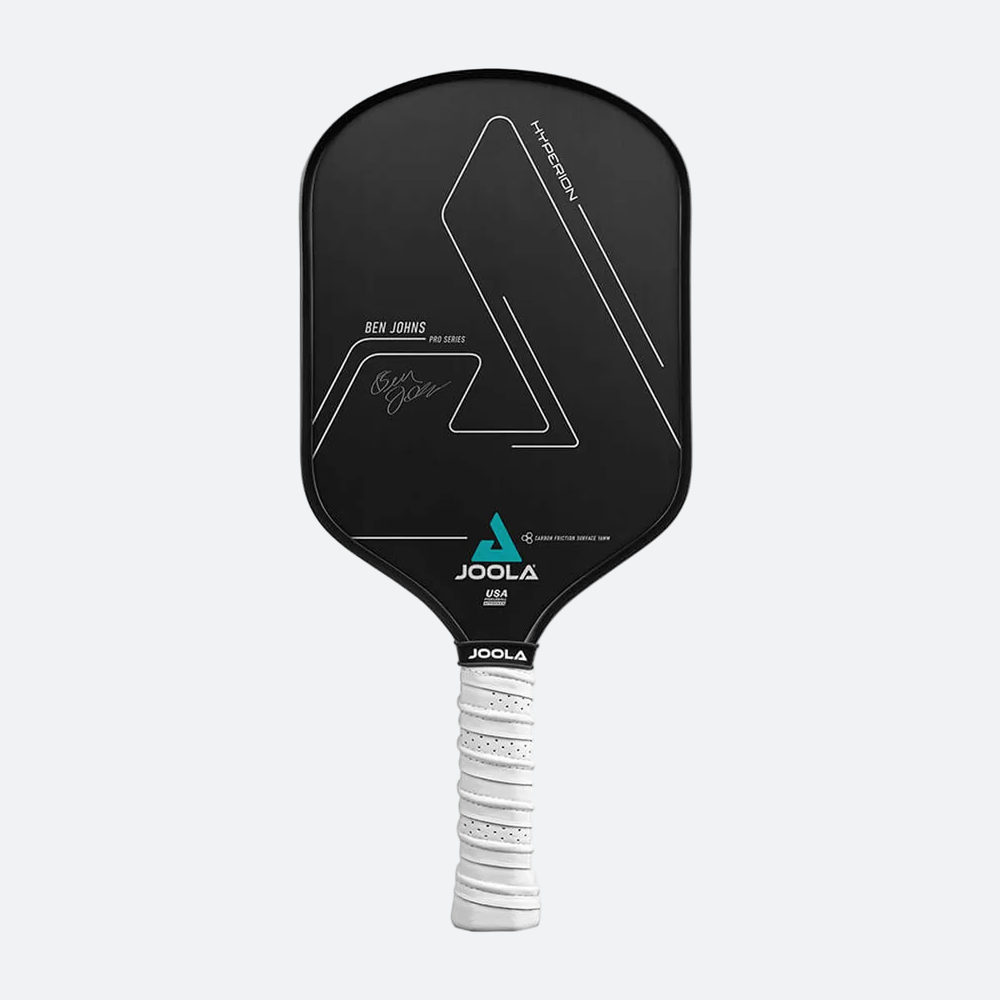
Six weeks with the paddle that launched a thousand comparisons. Is the Joola Ben Johns Hyperion 16mm still worth it now that it's dropped to around $160 in a crowded market?
What We Liked
- Exceptional consistency across the entire face
- Best-in-class touch on dinks and resets
- Raw carbon surface generates serious spin without feeling gimmicky
- Thermoformed construction feels premium and durable
- Well-balanced between kitchen play and baseline aggression
Watch Out For
- Still a premium price, and budget paddles now approach the same performance
- Not a dramatic upgrade from the previous Hyperion generation
- Raw carbon surface wears smooth after heavy use
Full Specifications
| Core | Reactive polymer honeycomb |
| Surface | Raw carbon fiber (carbon friction surface) |
| Thickness | 16mm |
| Weight | 7.8–8.2 oz |
| Handle Length | 5.5 inches |
| Grip Circumference | 4.25 inches |
| Paddle Length | 16.5 inches |
| Paddle Width | 7.5 inches |
| Shape | Elongated |
| USAP Approved | Yes |
| Price | $159.95 |
If you’ve been reading pickleball gear discussions for more than five minutes, you’ve encountered the Joola Ben Johns Hyperion. It’s the reference point everyone uses. Budget paddle companies explicitly market against it. Premium competitors try to outperform it. Ben Johns has won more tournaments than almost anyone else in professional pickleball — and this is his paddle.
I’ve now played the 16mm version for six weeks across recreational doubles, league play, and a 4.0 tournament. Here’s where it actually stands.
First Impressions
The Hyperion arrives in premium packaging that matches the price point. The carbon friction surface has that characteristic matte texture — not as aggressively rough as raw T700, but enough to generate meaningful spin. At 8.1 oz on my scale, it’s right in the middle of Joola’s specified range.
Build Quality
The thermoformed construction process bonds the face directly to the core under heat and pressure, eliminating air gaps that cause inconsistent feel across the face. This is what players mean when they call the Hyperion “consistent” — the sweet spot is large and the response is predictable whether you hit center, toward the tip, or closer to the throat.
The Kitchen Game
This is where the Hyperion earns its reputation. In long dinking exchanges, the 16mm polymer core creates a soft, controlled response that keeps the ball low and true. Third-shot drops are easier to dial in than on stiffer paddles — the ball releases at a predictable angle and stays where you aim it.
The spin is excellent. On topspin dinks, the ball grabs the face and kicks hard on the bounce. On slice serves and punch volleys, the carbon surface generates enough friction to create genuinely deceptive angles.
After switching to the Hyperion from a stiffer 13mm polymer paddle, my reset consistency improved measurably. The extra thickness absorbs pace better and the predictable face made difficult shots routine.
Baseline Power
The Hyperion doesn’t sacrifice pace for control. Full groundstrokes generate real ball speed, and the elongated shape provides extra leverage on baseline drives. Topspin serves kick aggressively.
The reactive polymer core stores and returns energy efficiently without the harsh feel of a Nomex core. It’s a balanced package — enough pop for aggressive play, enough feel for precision.
How It Compares
The Hyperion launched at $220, but it has since settled to around $160 — and that changes the math considerably. At $220 it was hard to recommend over a good budget paddle; at $160, the gap between it and a $100–110 paddle is only about $50.
Is that $50 worth it? For most recreational players, it’s a closer call than it used to be. The Hyperion is genuinely better — more consistent, better touch, more confidence-inspiring on difficult shots — but a 3.5 player won’t be meaningfully limited by a well-built budget paddle. At the new price, though, the premium is small enough that the decision comes down to feel preference as much as value.
For 4.0+ players who play frequently and care about equipment: the Hyperion is worth serious consideration. For players who want excellent performance without the premium: the market has caught up.
Who Should Buy This
Buy it if:
- You’re a 4.0+ player who plays 4+ times a week
- Touch, consistency, and kitchen play are your priorities
- You want the reference standard and budget isn’t a concern
Skip it if:
- You’re under a 3.5 skill level (the paddle’s advantages won’t translate)
- Budget is a real consideration
- You’re curious about foam core alternatives at half the price
The Verdict
The Joola Ben Johns Hyperion 16mm is still one of the best all-around paddles available. It’s not magic — no paddle is — and the market has produced real competition at lower prices. But it remains the benchmark for good reason: consistent, capable, and built to a premium standard.
If you’re ready to invest in your game and you play at a level where paddle consistency matters, the Hyperion delivers.
How we test
Every paddle on Dink Report is tested on court over multiple weeks of real play — not just unboxed and spec-checked. Ratings are independent and never influenced by whether a paddle was purchased or supplied. Read more about our review methodology.
More Reviews